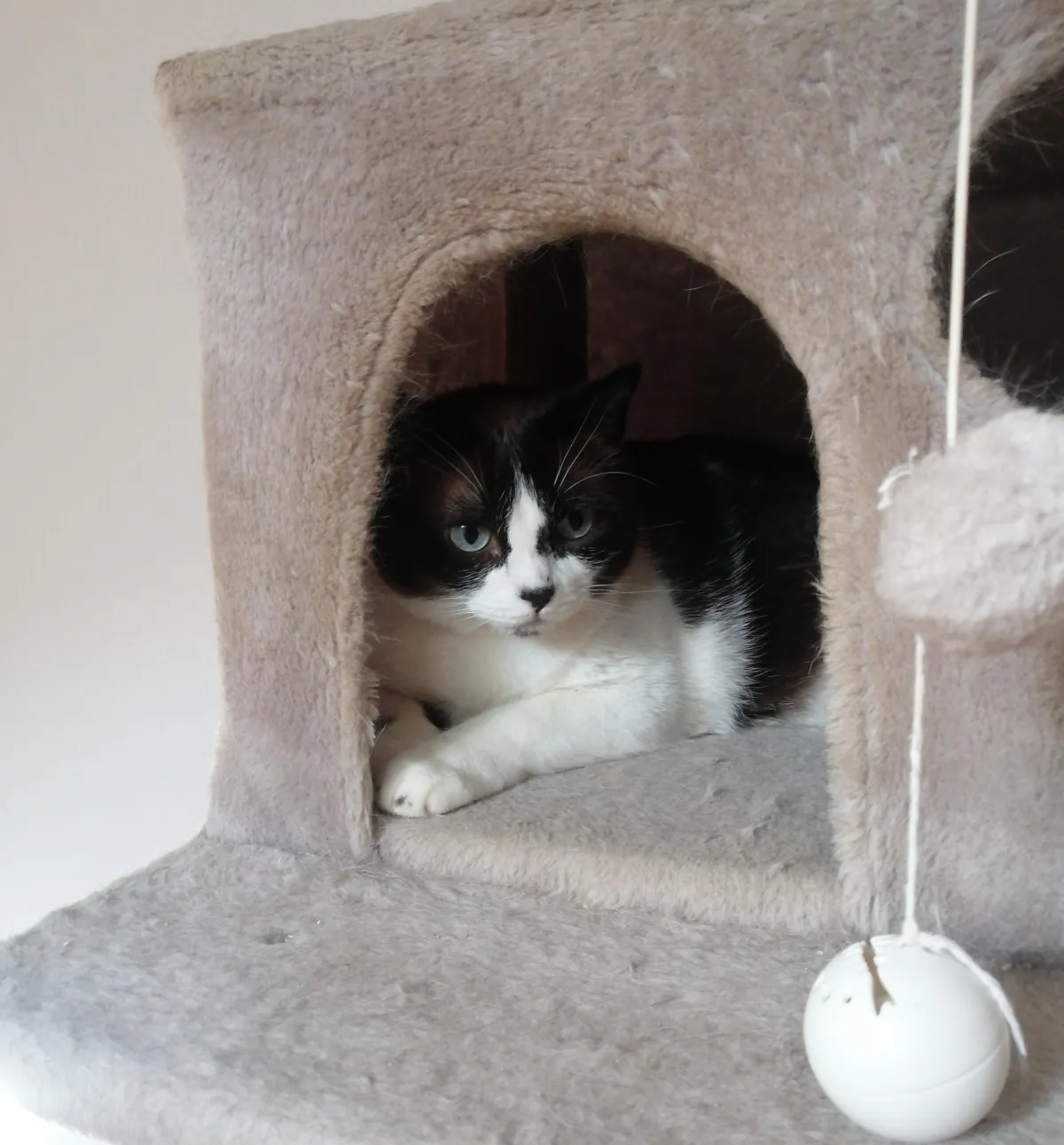
What your cat needs to be happy at home
Introduction: What your cat needs to be happy at home
What your cat needs to be happy at home
Introduction: What your cat needs to be happy at home
Can a cat live in an apartment?
Should cats be allowed outside?
Before bringing a cat home, it is important to realise that it is not just a pet — it is a curious, territorial and energetic creature.
Contrary to popular belief, a domestic cat does not need a huge house or access to the street to be happy; it needs a space that respects its natural behaviours.
In this article, I explain how to prepare your home and create the ideal environment for your cat, ensuring it has everything it needs to express its instincts, feel safe and live a peaceful life by your side.
Can a cat live in an apartment?
Yes, but it needs entertainment and somewhere to expend its energy, somewhere to be a cat!
We, as human beings, need to walk. If we are placed in a location without access to the outside, even if it is a large flat, we need to do some exercise...
What if we do exercise inside, but we are always walking around the same table in the same room? We might become frustrated... If we have company, we can discover new forms of entertainment and new conversations together.
A cat at home has nowhere to go for new conversation, nowhere to go for entertainment unless we provide it. So, an apartment cat depends heavily on us to give it attention and provide activity.
Should cats be allowed outside?
This is a very controversial issue. Actually, letting a cat roam freely is not legal in some countries. Check your local authorities or legislation for your specific governing law. It is known that cats that roam freely live much shorter lives, with the average being 2 - 6 years.
This is because cats can be run over, attacked by predators (yes, they hunt, but they are also hunted) or by people with bad intentions; they can also fight with other cats that have infectious diseases, they can acquire these diseases from animals they have hunted (the typical rat with leptospirosis) or they can become infested with parasites carried by their ‘prey’.
As much as we think they don't hunt and don't get into fights... Unless we put a camera on them, we can't be sure!
On the other hand, there is the issue of cats getting bored at home. Yes, that's true! Having their freedom is certainly a great pleasure for them, but we must be willing and prepared to deal with the negative aspects.
Do cats drink water?
Cat's wild ancestors were adapted to areas where free water could be limited, and prey provided an important source of moisture, so they were used to finding little water. They took advantage of the liquids found in their prey. Nowadays, a cat that lives indoors and therefore does not hunt needs to drink water, especially if it eats mainly dry food.
But there is a problem: an animal originating in the desert does not trust just any water... Water considered ‘good/healthy’ in a desert is running, crystal-clear water. And yes, the best way to give water to a cat is to give it to them through a fountain (as quiet as possible), or directly from the tap.
If they like the water, they will drink more and thus be less likely to develop kidney failure due to this same lack of water in their body.
Water should not be placed next to food. Cats like organisation, having everything in its place, and that place is separate: food in one place and water in another. On the other hand, we should have several points of access to water. We don't need five fountains, but one fountain and several bowls. Just to make sure that it's not because of a lack of options that they don't drink.
Food: Much More Than Just Filling the Bowl
Food can be distributed in different ways... If the animal spends a lot of time alone, why not hide it and make it exercise?
We're not starving them; we're giving them an incentive to move, and an animal that hunts 18 times a day in the wild really needs to move more than just going to the litter box and the food bowl... Food that is hidden but easy enough to reach at first creates more of a challenge and, in the end, a reward!
Who doesn't like to know they can overcome challenges? They do too! It releases satisfaction hormones, and that's what will keep them happy in our home.
Freedom of choice.
We like to have autonomy, and who doesn't? We like to choose what to do next, what to eat, where to sit or lie down, and we can stop or be active whenever we want... Well, cats surely do too! In fact, it's easy to tell when a cat is frustrated: it becomes restless, destroys things we like (and does so while looking at us), and sometimes even "attacks" us.
Let's give them a chance to choose. This doesn't mean they'll be able to sit or sleep wherever they want or play with whatever they feel like. It means we'll give them options that we know they'll appreciate.
High places where they can enjoy what is happening around them without feeling observed or threatened; after all, they don't have to like everyone or every other animal either!
Two litter boxes(for a single cat), one open and one closed; two types of litter, for example... Each box has its function: The closed one is better for keeping litter from scattering, but what if he doesn't like it? An open one is easy for us to clean, but... What if there is another animal in the house that disturbs him when he is doing his business? Well, he will no longer feel safe in that tray and will look for other places. That's how we often find surprises! The best way? Give it options
Toys: We can buy very expensive toys, but we should give them the opportunity to choose the ones they want to use. Sometimes they are even the ones we make for them by hand! There's the option of interactive toys also. Why not? An interactive toy allows them to expend energy whenever they want, even without us, but...
Play with them!
Another important thing is that they don't always want to play alone... They consider us part of the family, so they like to play with us; it's a form of interaction. If we brought them into our home, let's give them about 15 minutes of playtime, once or twice a day, at least...
Conclusion — Talking Cat Means Loving Attentively
Understanding our cat is a process of observation, empathy, and patience. Every glance, every sound, and every movement is a message.
The more we learn to “hear” them, the more peaceful and happy the life we share with them will be.
Deep down, speaking cat is just that — a new way of loving with attention. 🐾


